


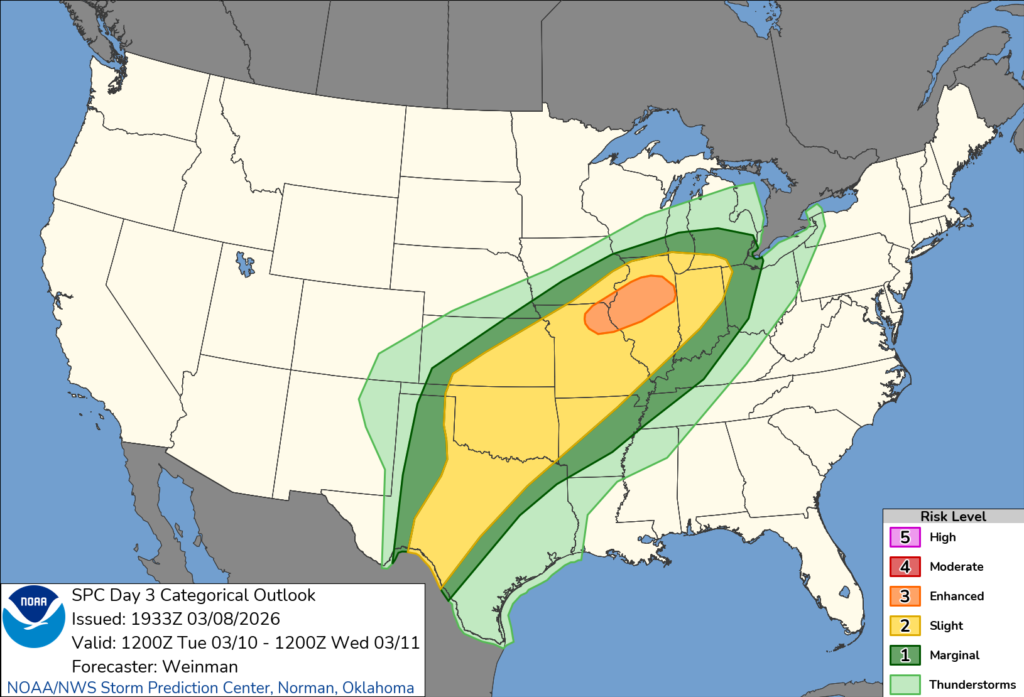
OHIO — Parts of Ohio could see severe thunderstorms Tuesday as a large storm system moves from the Plains toward the Great Lakes, according to the National Weather Service’s Storm Prediction Center.
In an outlook issued Sunday evening, forecasters said scattered severe thunderstorms are expected to develop from the southern Plains into the southern Great Lakes region Tuesday and continue into the overnight hours.
Portions of western and northern Ohio are included in a Slight Risk (Level 2 of 5) for severe storms, while other areas of the state fall within a Marginal Risk (Level 1).
Meteorologists say the storms will be fueled by a developing weather pattern that includes a strengthening upper-level trough moving east across the southern Plains and another system amplifying across the northern Plains and Upper Midwest. At the surface, a warm front is expected to extend eastward toward the southern Great Lakes region from a low-pressure system over the middle Mississippi Valley.
South of this boundary, warm and humid air will spread northward across the Midwest, helping create conditions favorable for thunderstorms. Dew points are expected to climb into the middle to upper 60s, providing the moisture needed for storm development.
Forecasters say a strengthening low-level jet during the evening and overnight hours will increase wind shear in the atmosphere. This environment could support organized thunderstorms, including clusters of supercells capable of producing damaging wind gusts, large hail and a few tornadoes.
Storms that develop earlier in the day across the middle Mississippi Valley could move northeast into the Ohio Valley and southern Great Lakes region, potentially bringing severe weather to parts of Ohio overnight Tuesday into early Wednesday. However, the Storm Prediction Center noted that confidence in the exact track and intensity of storms remains uncertain several days in advance.
Residents across Ohio are encouraged to monitor updated forecasts as the system approaches, as the timing and location of the most intense storms may change.