


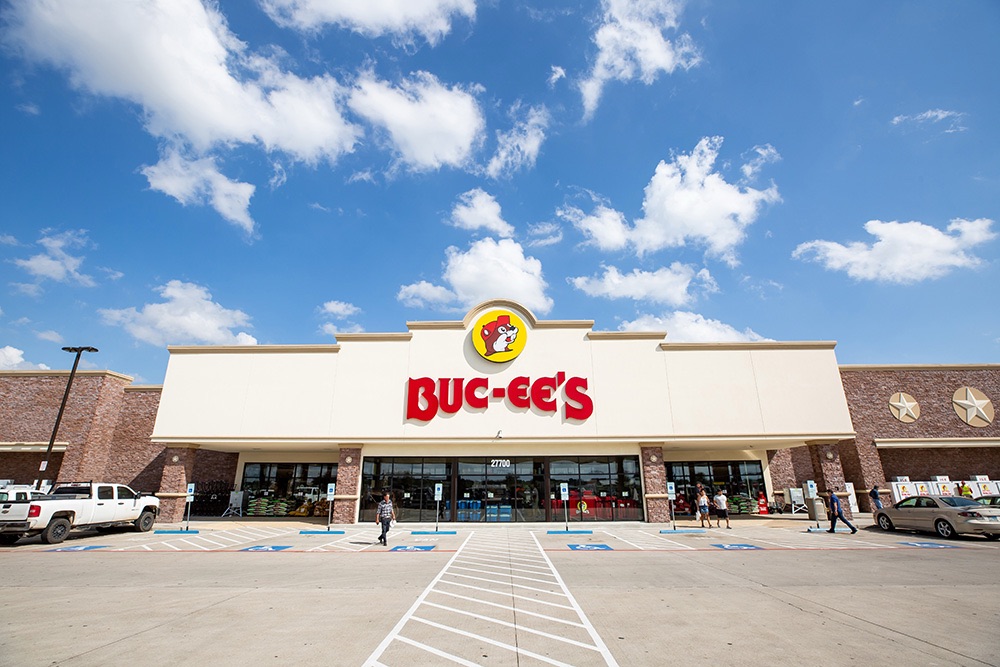
MARYLAND — Maryland sits on some of the busiest travel corridors on the East Coast, but a Buc-ee’s is not the kind of retailer that can simply drop into any commercial strip and flip on the lights. The Texas-based chain’s modern travel centers are built at a scale that typically requires interstate traffic, a large tract of land and local government approvals that can take months or years.
A public project narrative filed for a proposed Buc-ee’s in Stafford County, Virginia, shows the kind of footprint the company often pursues: a store area of about 74,000 square feet, 120 fueling positions (60 multi-product dispensers arranged in 30 islands), and hundreds of parking spaces—with that Virginia proposal showing 833 spaces to accommodate longer customer visits than a typical convenience store.
That same filing highlights another recurring feature of Buc-ee’s developments: the need for land-use approvals such as conditional use permits for high-intensity retail, vehicle fuel sales, and oversized signage, plus rezoning when existing zoning does not allow the use by-right.
Those realities help explain why Maryland does not currently have a confirmed Buc-ee’s project. Recent reporting around the chain’s growth has focused on new builds and openings in other states, including the opening of Buc-ee’s first Virginia location on June 30, 2025, along Interstate 81—its northernmost outpost at the time—while online chatter about a Maryland location near Hagerstown has been described in regional coverage as unconfirmed.
What it would take in Maryland
For Maryland to land a Buc-ee’s, several conditions would likely need to line up:
A large, development-ready site near an interstate interchange. Based on the Virginia development filings, Buc-ee’s sites commonly demand tens of acres, extensive parking, and room for large fuel canopies and internal circulation.
Supportive zoning and predictable permitting. Because a Buc-ee’s combines high-volume fuel sales, high-intensity retail, and often very prominent signage, a host jurisdiction must either already allow those uses or be willing to grant rezoning/conditional use approvals—often with transportation “proffers” or required road upgrades.
Strong traffic counts and a workforce. Communities courting Buc-ee’s frequently emphasize heavy pass-through travel and local job capacity. One economic development write-up citing Buc-ee’s general counsel describes the company as looking first for sufficient traveler volume, then business-friendly jurisdictions, and a good workforce.
Transportation and environmental review that can survive scrutiny. Buc-ee’s proposals can draw opposition over traffic, air quality and other impacts, making traffic studies and environmental safeguards central to winning approvals.
Logical Maryland locations
If the company ever targets Maryland, the most logical options are places that combine long-distance travel demand with available land near major interchanges:
- I-95 in Cecil County (Elkton/North East corridor): A true “through-traffic” market between Philadelphia and Baltimore/Washington, with interchanges that already serve travel plazas and distribution uses.
- Hagerstown area (I-70/I-81 junction): A crossroads for traffic moving between the Mid-Atlantic and Appalachia; it is also the area most often mentioned in online speculation, though not confirmed in mainstream reporting.
- Frederick County (I-70/I-270 vicinity, but outside dense development): A high-volume gateway between the Washington suburbs and western Maryland—though land costs, congestion and permitting complexity could be hurdles compared with more rural interchanges.
- I-68 approaching western Maryland (near Cumberland): A smaller population base, but heavy seasonal and cross-state travel could appeal if a site offered easy highway access and sufficient acreage.
In short, a Maryland Buc-ee’s is possible in the sense that the state has the highway traffic the chain tends to seek—but it would likely take a large, interchange-adjacent parcel, local political buy-in for zoning and infrastructure, and a permitting path that can handle the scale of a 70,000-plus-square-foot travel center with extensive fueling and parking.