


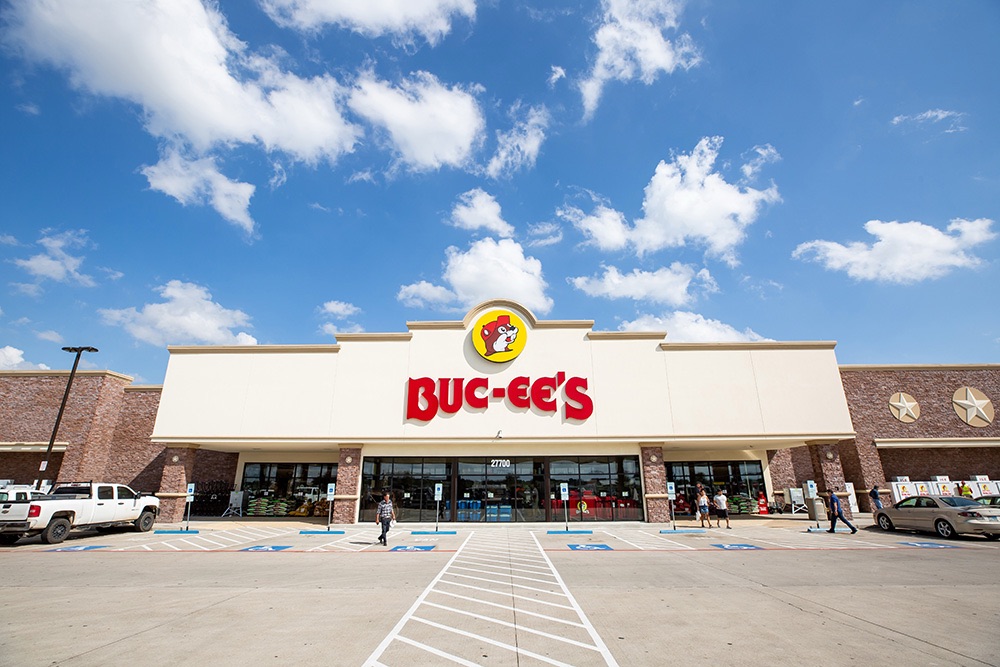
NEW JERSEY — Buc-ee’s has become a destination stop in the South and Midwest by pairing an oversized convenience store with a massive fueling operation designed to pull in interstate travelers.
For New Jersey, the question is less about brand interest and more about whether a developer can line up the right tract of land, the right highway access, and the permits needed to build something that typically resembles a small retail campus.
Buc-ee’s recent projects commonly involve a store footprint around 74,000 square feet and roughly 120 fueling positions, numbers that appear repeatedly in public reporting and in development filings tied to proposed locations.
Those dimensions are the starting point for what New Jersey would require: enough acreage for the store, pump canopies, tanker circulation, stormwater infrastructure, employee and customer parking, and traffic improvements—plus a local zoning framework that allows a large-scale fueling center and high-intensity retail.
The big New Jersey-specific hurdle: gasoline is still full-service
Unlike most states Buc-ee’s operates in, New Jersey prohibits customers from pumping their own gasoline and requires dispensing by trained attendants. That does not make a Buc-ee’s impossible, but it changes the operating model. A site with dozens of pump islands would need a staffing plan sized for New Jersey’s rules—more labor, different traffic flow at the pumps, and training and compliance practices tailored to state requirements.
New Jersey also requires safety features such as remote emergency shut-off capability for pumps—part of the regulatory baseline any large station must design around.
The development checklist: land, access, and approvals
To get a Buc-ee’s-sized project over the finish line in New Jersey, a developer would typically have to clear several practical gates:
1) Assemble a large tract with the right zoning.
Buc-ee’s-scale sites elsewhere often use 30–40 acres (or more) to comfortably fit the building, fuel canopy layout, and circulation, while still meeting setbacks, landscaping, and buffering needs. A letter of intent tied to a Buc-ee’s project elsewhere lists a 40-foot building height and a very large fueling layout, illustrating how quickly space requirements balloon. In New Jersey, finding that much contiguous land near major interchanges—without wetlands constraints or incompatible neighboring uses—is the first major challenge.
2) Secure highway visibility and easy interchange access.
Buc-ee’s thrives on quick “off-and-on” travel. The most viable New Jersey locations would be at or near limited-access highway interchanges with heavy long-distance traffic (interstate corridors rather than purely local commuter routes). That usually means traffic engineering, turning-lane builds, signal timing upgrades, and sometimes new access roads—improvements that can become a make-or-break factor during local and county review.
3) Navigate environmental and fuel-system permitting.
Any facility dispensing fuel at this scale must comply with a range of state requirements around storage, vapor control, and fuel dispensing operations. New Jersey DEP provides compliance guidance for fuel dispensing facilities and administers permitting pathways for equipment associated with storage/transfer and related environmental controls. Depending on design choices—underground vs. aboveground storage, generator use, and other equipment—additional air, stormwater, and site-impact reviews can come into play.
4) Win local land-use approvals and manage community concerns.
Even when zoning technically allows a travel center, a project of this size often triggers conditional-use approvals, public hearings, and negotiated conditions (hours, lighting, signage, buffering, traffic mitigations). In other states, proposed Buc-ee’s locations have required zoning or permit actions at the local level, underscoring that community process is a standard part of the playbook.
5) Make the economics work.
A Buc-ee’s is not just a gas station; it is a major retail employer and sales-tax generator. Some jurisdictions have used incentives tied to job creation and long-term tax receipts to help land such projects. In New Jersey—where land and construction costs are generally higher—municipal incentives, redevelopment tools, or infrastructure participation could be decisive.
The most logical New Jersey corridors
While Buc-ee’s has not publicly announced a New Jersey project through official channels in the sources above, the most logical target areas are where New Jersey best matches Buc-ee’s core requirement: nonstop, multi-state highway traffic with room to build.
South/Central Jersey: I-295 / NJ Turnpike corridor (between Philadelphia and the Shore, and on the I-95 spine).
This is the state’s clearest match for “road-trip volume.” A site near major interchanges—where travelers are moving between the Mid-Atlantic and New York/New England or cutting toward shore points—offers Buc-ee’s the broadest draw. The strongest candidates are areas with available industrial/commercial land and fewer build-out constraints than North Jersey.
Central Jersey: Route 1–9 / Turnpike feeder markets with large, developable parcels.
Buc-ee’s benefits when it can capture both interstate travelers and regional weekend traffic. Central Jersey has the population density to support the retail side, but the project would need to avoid locations where congestion makes access painful—because long queues at entrances can sour the “quick stop” promise.
Western NJ: I-78 corridor near the Pennsylvania border.
I-78 is a major freight-and-travel route from the Lehigh Valley toward the New York metro area. A Buc-ee’s here could function as a “last big stop” before denser North Jersey traffic. The key would be finding acreage near an interchange that can absorb peak surges without snarling local roads.
Less likely: North Jersey interchanges near I-80 / I-287.
Traffic is heavy, but land is tighter, permitting can be more complex, and interchange areas are often already built up. A Buc-ee’s could work only if a rare large tract is available and roadway improvements are feasible without major community pushback.
Bottom line
For Buc-ee’s to construct a New Jersey location, it would likely take a developer-controlled site of roughly “big box + travel center” scale, immediate interstate access, a local government willing to accommodate significant traffic and infrastructure work, and a compliance plan built around New Jersey’s full-service gasoline rules and environmental permitting requirements.
If those pieces align, the most logical landing spots are not in the densest North Jersey suburbs, but along high-volume corridors in South and Central Jersey—where the state still has the space to build a Buc-ee’s large enough to function like the roadside destination it’s designed to be.