


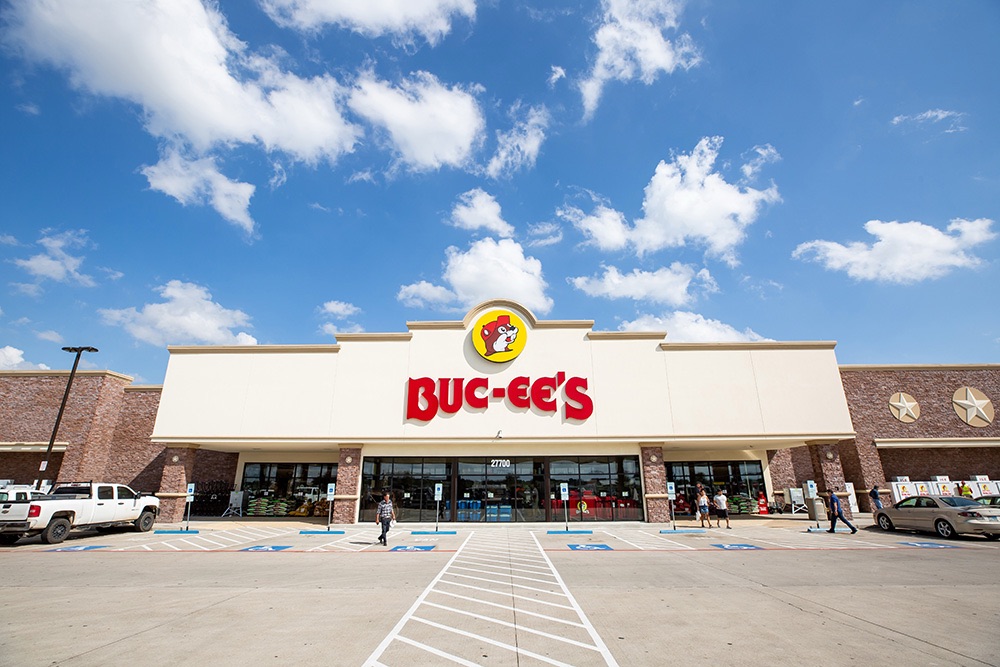
PENNSYLVANIA — Buc-ee’s has not announced a Pennsylvania location, and reporting in 2024–2025 noted the company had been quiet publicly about any concrete plans even as Buc-ee’s-themed billboards appeared along the Pennsylvania Turnpike.
But based on how Buc-ee’s builds and operates elsewhere, a Pennsylvania entry would likely hinge on a short list of practical requirements: a very large site, interstate access, heavy traffic flow, local approvals, and room to manage significant traffic impacts.
The size and layout Pennsylvania would have to accommodate
Buc-ee’s is not a typical convenience store. Newer travel centers commonly run around 74,000–76,000 square feet with about 120 fueling positions, and they can employ 200+ workers depending on the site. Those formats generally require tens of acres of developable land near an interchange, plus room for extensive parking, circulation lanes, stormwater controls, signage, and multiple driveways.
Another operational reality: Buc-ee’s is widely known for limiting access for tractor-trailers/18-wheelers (beyond deliveries), which affects site design and where it fits in the travel-stop ecosystem. In Pennsylvania—where truck traffic is heavy on certain corridors—that policy can shape where a store is welcomed and how traffic is managed.
The approvals and infrastructure hurdles
Wherever it goes, a Buc-ee’s-scale project typically brings major traffic engineering requirements and can become a high-profile local land-use case. Local governments often require traffic studies, roadway improvements, turn-lane work, signal changes, and coordination with state transportation agencies, because the store can attract steady all-day traffic rather than a brief rush-hour pattern. (Several jurisdictions have treated Buc-ee’s proposals as traffic-intensive developments that need detailed review.)
In Pennsylvania, the most common make-or-break factors would likely be:
- Zoning and conditional-use approvals for a large fueling facility/retail complex
- PennDOT highway occupancy permits and interchange-area access management
- Utility capacity (water/sewer) and stormwater compliance for a very large paved footprint
- Community acceptance, because noise, lighting, traffic backups, and land consumption are frequent flashpoints in Buc-ee’s proposals
Why Pennsylvania could be attractive anyway
Buc-ee’s expansion has been moving steadily north and into new states, including its Virginia debut and other announced projects, showing the company is willing to follow major interstate travel patterns beyond its original footprint. Pennsylvania sits at the crossroads of multiple long-haul and regional corridors and has a deep bench of road-trip and commuter traffic—exactly the kind of volume the chain targets.
Logical Pennsylvania corridors and “short list” locations
Without predicting a specific site, the most logical areas are places with (1) nonstop highway volume, (2) easy on/off ramps, (3) large parcels, and (4) distance from dense built-out suburbs where land assembly is difficult.
1) South-central Pennsylvania: I-81 / I-83 / Turnpike hub (Carlisle–Harrisburg–Mechanicsburg area)
This region is one of the state’s biggest highway junction zones, capturing north–south and east–west traffic. It also has more greenfield-style development opportunities than the Philadelphia or Pittsburgh inner suburbs—important for a high-acreage project.
2) Lehigh Valley: I-78 / Route 33 / I-476 access (Allentown–Bethlehem perimeter)
I-78 is a major freight-and-travel corridor between central Pennsylvania and North Jersey/NYC markets. The challenge here is land cost and congestion, so the “logical” play would be just outside the densest areas where parcels are larger and traffic can be engineered.
3) Western PA: I-79 / PA Turnpike (Cranberry Township–Butler County vicinity)
North of Pittsburgh, I-79 and the Turnpike influence substantial regional travel. A Buc-ee’s here would serve Pittsburgh-area road trips while also catching interstate travelers heading north/south.
4) North-central PA: I-80 (Clearfield/DuBois corridor)
I-80 is Pennsylvania’s main cross-state drive. For a travel-center model, the best fit is typically mid-route, where drivers are primed to stop and where large parcels near interchanges can still be found.
5) Eastern Turnpike corridor: Lancaster–Berks area (near the PA Turnpike spine)
This one comes up in public speculation partly because billboards have been spotted near Turnpike exits in that region. Practically, the corridor has strong traffic, but site selection would still come down to land availability and the ability to build the required access improvements without creating chronic backups.
The bottom line
For Buc-ee’s to open in Pennsylvania, it would likely take a large, interchange-adjacent parcel; PennDOT and local government buy-in for significant traffic and roadway work; and a host community willing to accept a destination-scale travel center that can reshape an interchange area. And if it does happen, the most logical targets are Pennsylvania’s interstate crossroads—especially I-81/I-83/Turnpike south-central, I-78 Lehigh Valley outskirts, I-79 north of Pittsburgh, and I-80 mid-state.